
Phase Changes
What is a Phase Change?
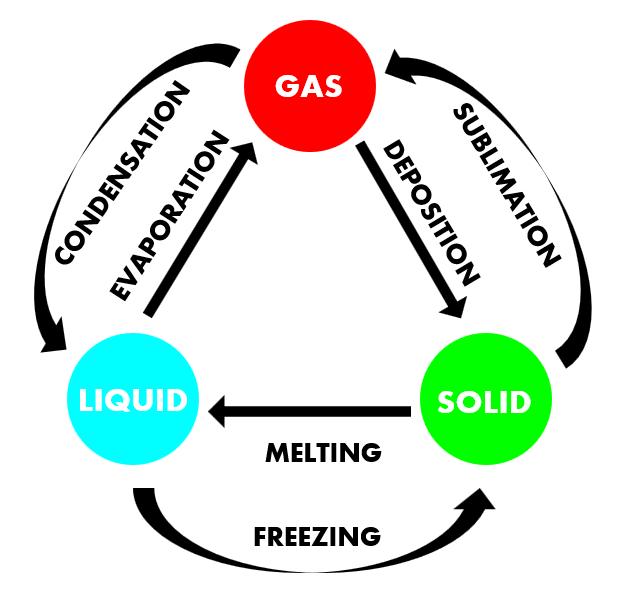
A phase change is the transition of matter from one state to another. There are six main types of phase changes: melting (solid to liquid), freezing (liquid to solid), evaporation (liquid to gas), condensation (gas to liquid), sublimation (solid to gas), and deposition (gas to solid). These changes occur when matter gains or loses energy, causing the particles to move faster or slower and reorganize into different structures. Phase changes are fundamental to understanding how matter behaves under different temperature and pressure conditions.

How Do Phase Changes Occur?
Phase changes occur when heat energy is added to or removed from matter. When heat is added, particles gain energy and move faster, causing them to break free from their current structure. This leads to endothermic phase changes like melting, evaporation, and sublimation. Conversely, when heat is removed, particles lose energy and move slower, causing them to come together more closely. This leads to exothermic phase changes like freezing, condensation, and deposition. The temperature at which a phase change occurs is specific to each substance and is called the melting point, boiling point, or sublimation point depending on the type of change.
Phase changes are essential in nature and technology. Water's phase changes between ice, liquid water, and water vapor drive Earth's water cycle, which is critical for weather patterns and life. In industry, phase changes are used in refrigeration systems, heat pumps, and power generation. Understanding phase changes helps us predict how materials will behave at different temperatures and is crucial for applications ranging from cooking and freezing food to designing spacecraft that can withstand extreme temperatures. Every substance has unique phase transition temperatures that determine its state under specific conditions.
For references of the different states of matter, take a look at our other pages.